How To Calculate Lean Body Weight?
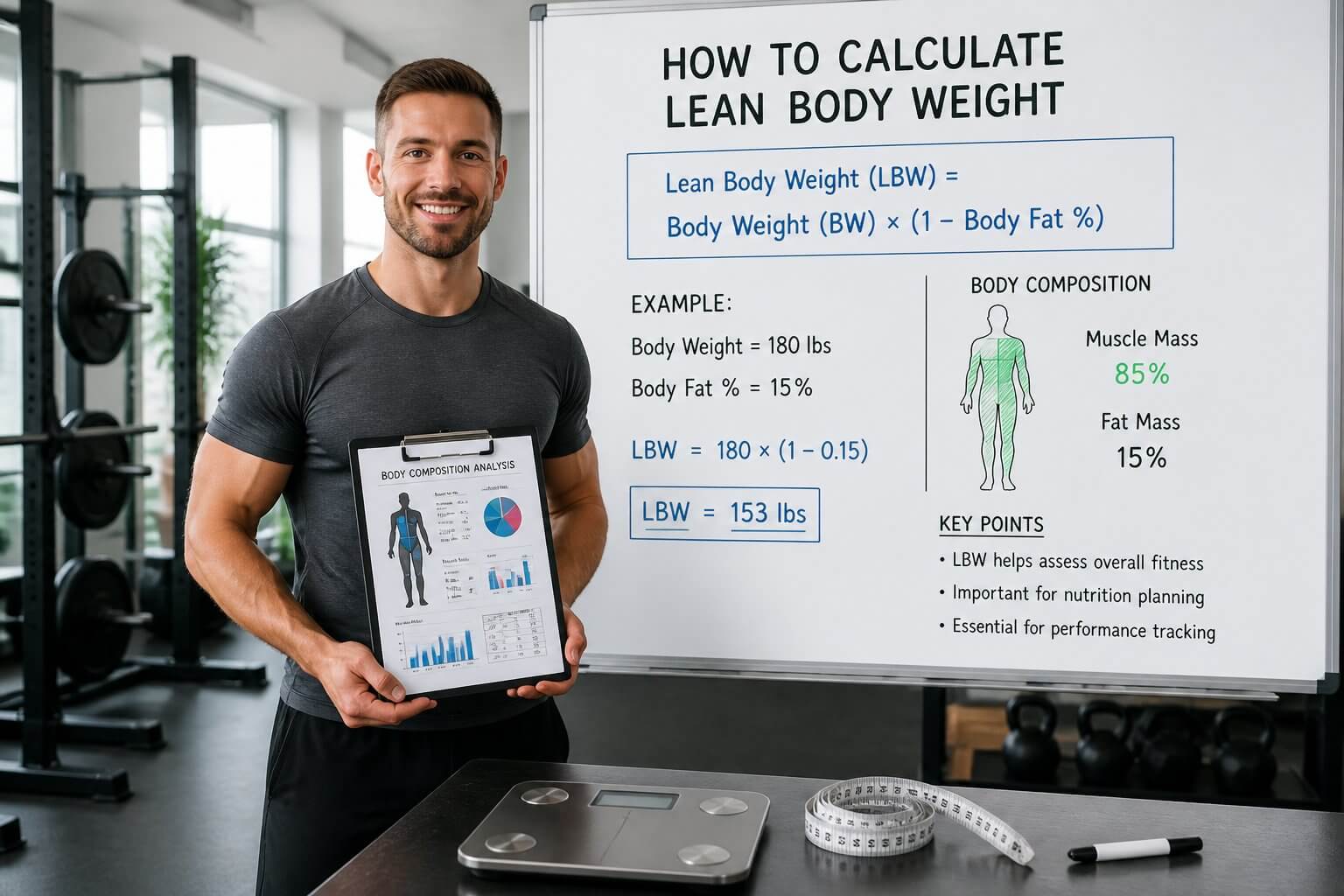
Lean body weight is everything in your body that is not fat: muscle, bone, organs, and water. Clinicians use it to dose certain medicines safely, since many drugs act on lean tissue. For the rest of us, it sharpens training and body goals.
Want your fat free weight?
Try the Lean Body Weight CalculatorThe Hume formula
A trusted equation comes from R. Hume. It blends your weight and height with factors set by sex to estimate lean mass in kilograms. Men and women use slightly different numbers, since average muscle and bone differ.
Boer and James offer close alternatives, each tuned a little differently. Results land near one another, so any of them gives a sound estimate.
Why lean weight matters
Fat and lean tissue behave differently. Muscle burns more energy at rest, supports strength, and shapes how you look. Tracking lean weight, rather than total weight alone, shows if a diet protects muscle or quietly burns it.
Medicine cares too. Dosing some drugs by lean weight avoids overshooting in people who carry more fat.
A worked example
Picture a man at 80 kilograms and 180 centimetres. The Hume equation multiplies his weight and height by set factors, then subtracts a constant, landing near 60 kilograms of lean mass. The remaining 20 kilograms is roughly fat weight.
Skip the arithmetic with our Lean Body Weight Calculator. Compare it with the Lean Body Mass Calculator, measure fat on the Body Fat Calculator, and check muscle with the FFMI Calculator.
Building and keeping it
Lift weights to grow and protect lean mass, and eat enough protein to fuel it. Crash diets strip muscle along with fat, so keep deficits gentle. For background on body composition in health, the National Institutes of Health offers solid reading.
Protecting lean mass
Muscle is hard to build and easy to lose, so guarding it pays off. Strength training two or three times a week sends the signal to keep lean tissue, even during a diet. Pair that with enough protein, around 1.6 to 2.2 grams per kilogram, to supply the raw material.
Gentle deficits protect what training builds. Slashing calories too hard burns muscle alongside fat and slows your metabolism. A modest cut, steady sleep, and patience keep more of your lean mass intact while fat falls.
Watch lean weight, not only the scale. A number that holds steady while the mirror improves usually means fat is leaving and muscle is staying, which is exactly the goal. Recheck every few weeks, adjust food and training gently, and let lean body weight guide a smarter, stronger approach to body change.
In short, lean body weight captures everything but fat, and it sharpens both medicine and training. Estimate it with the Hume formula, then watch it alongside the scale rather than instead of it. Protect that lean mass with regular strength work, ample protein, and gentle deficits, since crash diets burn muscle too. A lean weight that holds while the mirror improves is the clearest sign of real progress. Use the number to build a body that is not just lighter, but stronger.