How Do You Calculate Date Of Conception?
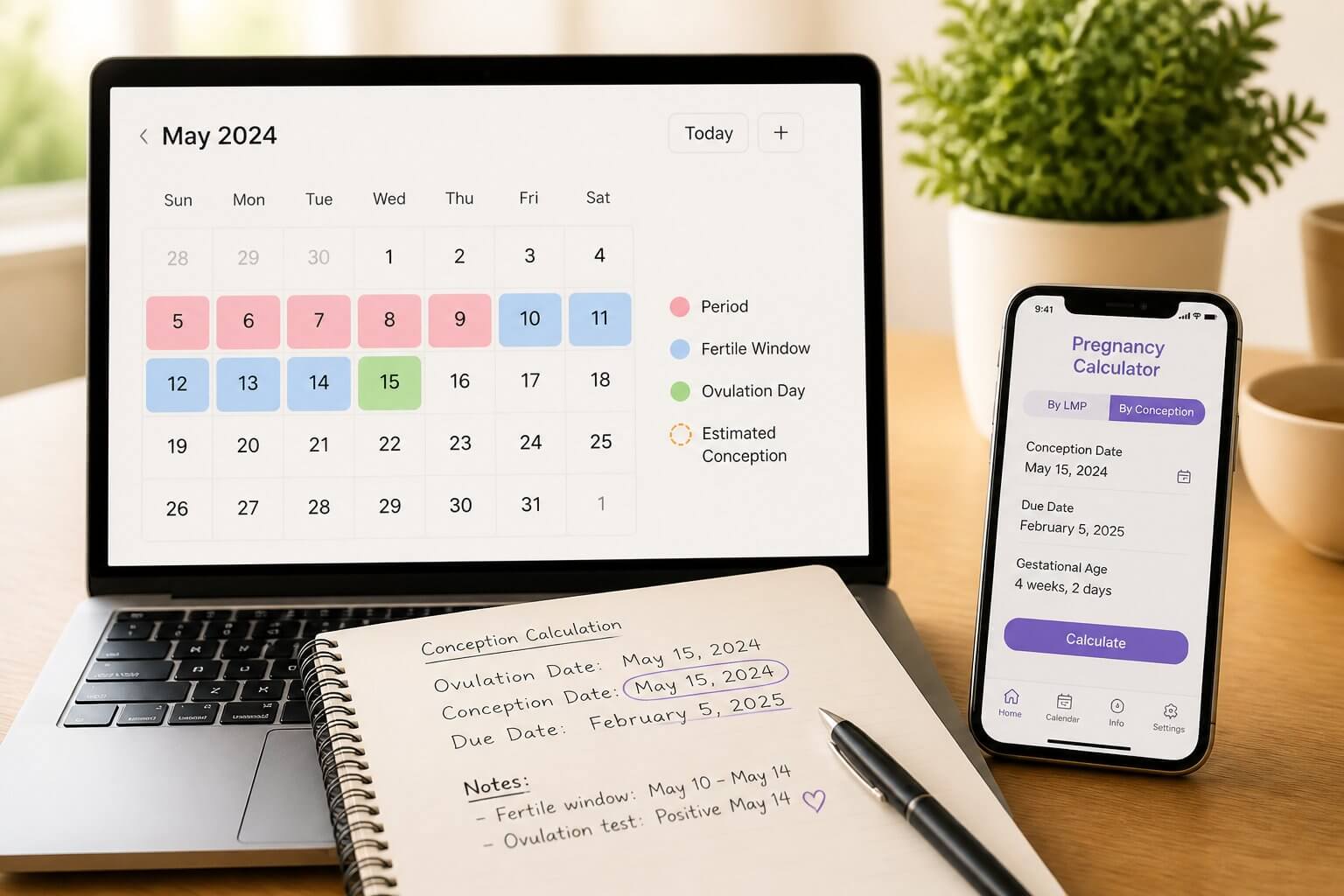
Conception is the moment an egg meets sperm and a pregnancy begins. Pinning the exact day is tricky, since it happens quietly inside the body. Still, a couple of reliable methods narrow it to a short window using your cycle or your due date.
Want your likely date?
Try the Conception CalculatorWorking back from your last period
Cycle dating is the common path. In a textbook 28 day cycle, ovulation lands near day 14, and conception follows within a day or two. Count about 14 days forward from the first day of your last period, and you reach the likely date.
Cycles vary, of course. A longer cycle pushes ovulation later, a shorter one pulls it earlier. Tracking signs like temperature and cervical mucus sharpens the estimate.
Working back from a due date
Due dates also point backward. Since pregnancy runs about 266 days from conception, subtracting 266 days from the due date lands near the day you conceived. This route shines when an ultrasound has already set a firm due date.
Both methods give a window, not a single certain day. Sperm can survive several days, so the fertile span covers more than one date.
A worked example
Picture a last period that started on the first of the month, with a regular cycle. Add 14 days and conception likely fell around the fifteenth, give or take a couple of days. From a known due date, count back 266 days for the same answer.
Let our Conception Calculator do the counting. The Ovulation Calculator maps your fertile window, and the Pregnancy Calculator tracks the weeks that follow.
Reading the result
Treat the date as an estimate, useful for planning and curiosity. For medical dating, an early ultrasound remains the gold standard. To understand fertility and timing, the American College of Obstetricians and Gynecologists offers trustworthy reading.
Signs that narrow the window
Your body offers clues if you watch for them. Around ovulation, cervical mucus turns clear and stretchy, much like raw egg white. Basal body temperature ticks up slightly after the egg releases, and some people feel a brief twinge on one side. Tracking these signs across a few cycles sharpens any estimate.
Cycle length shifts the math more than people expect. A 35 day cycle pushes ovulation later than the textbook day 14, while a short cycle pulls it earlier. Counting from your own average, rather than a generic 28 days, lands closer to the truth.
Remember the fertile window spans several days, since sperm can survive inside the body for up to five. That is why conception lands in a range, not on one certain date. For planning or simple curiosity, the estimate works well; for medical dating, an early scan rules.
In summary, conception falls within a short window you can estimate from your cycle or your due date. Add about 14 days to your last period, or count back 266 days from a confirmed due date, and you land near the day. Watch your body's signs to sharpen the guess, and remember the fertile span covers several days. For planning and curiosity the estimate serves well, while an early scan stays the gold standard for medical dating.