How To Calculate Body Surface Area?
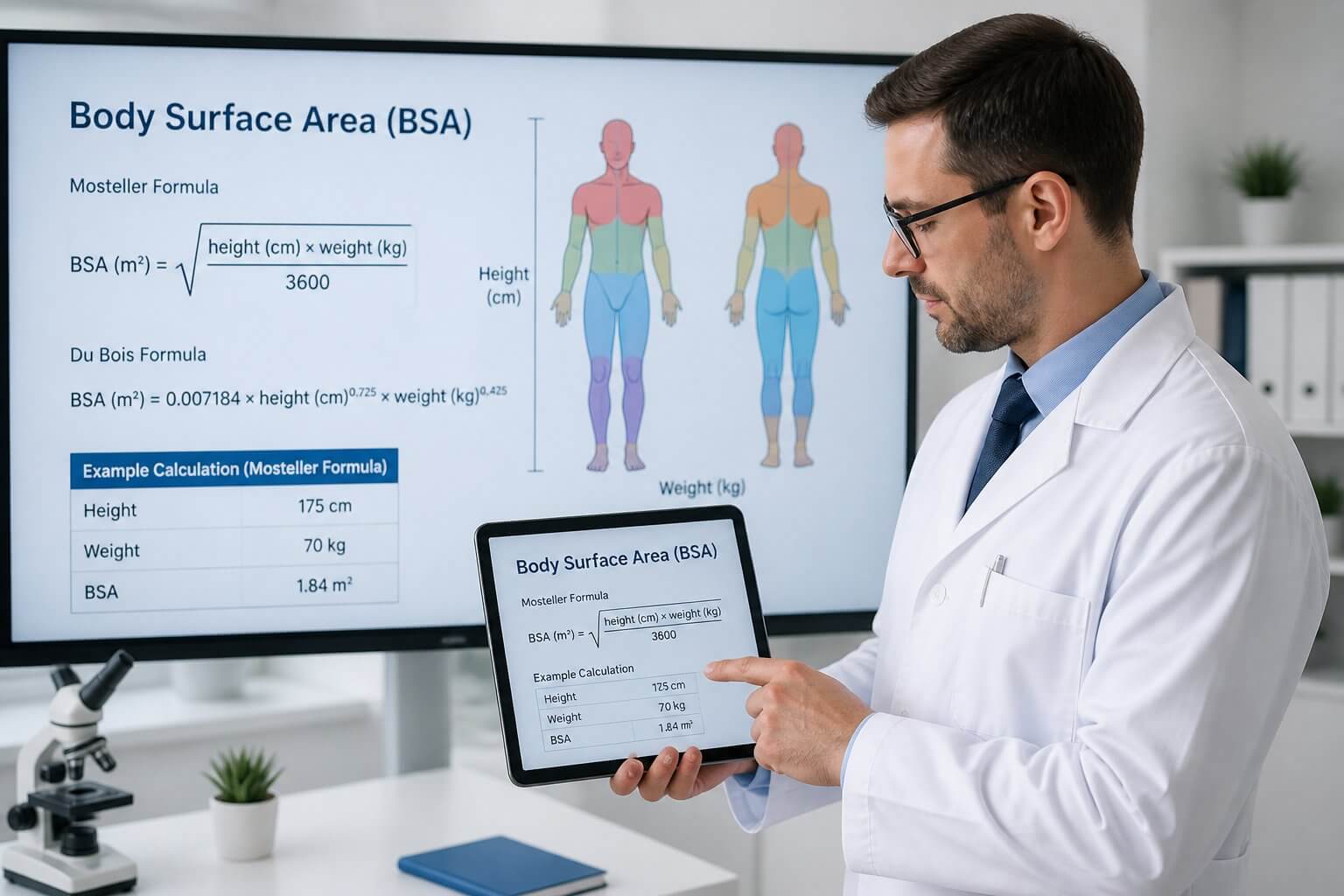
Body surface area, or BSA, estimates the total outer area of your skin in square metres. Doctors use it more than weight for many tasks, since it tracks closely with how the body handles drugs and fluids. Chemotherapy doses, in particular, often rest on this single number.
Need your BSA in seconds?
Try the Body Surface Area CalculatorThe Mosteller formula
Simplicity made the Mosteller equation the favourite. Take your height in centimetres, multiply by your weight in kilograms, divide by 3600, then take the square root. Out comes your BSA in square metres. Most adults land between 1.6 and 2.0.
Other equations exist, such as Du Bois and Haycock, and each weighs height and weight a little differently. Results sit close together, so Mosteller wins on speed and clarity.
Why BSA beats weight alone
Weight ignores how tall you stand. Two people at one weight can have very different frames, and that changes how a dose should scale. BSA folds height and weight into a single figure, which maps better onto blood volume, heart output, and kidney work.
Clinicians lean on it for safety. A dose tuned to BSA lowers the risk of giving too much to a small patient or too little to a large one.
A worked example
Picture someone 170 centimetres tall who weighs 70 kilograms. Multiply 170 by 70 to get 11,900. Divide by 3600 and you reach about 3.31. Take the square root and the BSA lands near 1.82 square metres. Swap in your own numbers and the steps never change.
Keep your inputs accurate for the cleanest figure. Measure height without shoes and use a recent weight, since small errors shift the square root only slightly.
Reading your result
Use BSA as a reference, not a verdict on health. It says nothing about fat, fitness, or muscle. For dosing or any medical choice, a professional must apply it with full context. Skip the math with our Body Surface Area Calculator, and pair it with the Blood Volume Calculator and the BMI Calculator. For background on body measurements in care, the National Institutes of Health offers reliable reading.
Where BSA shows up in care
Hospitals reach for BSA more often than patients realise. Oncology teams scale chemotherapy to it, since a dose that suits a small frame could overwhelm it while underdosing a larger one. Kidney specialists use it to index filtration, and burn units lean on related body maps to judge severity.
Accuracy still rests on clean inputs. Measure height without shoes, stand tall, and use a recent weight taken at a steady time of day. A small slip in either number barely moves the square root, yet careful figures always serve you better, above all in a clinical setting.
Read the result as one piece of a bigger picture. BSA says nothing about fat, fitness, or strength; it only describes size. Doctors combine it with lab values, age, and history before any decision, and you should treat your own number the same calm way.
To sum up, body surface area packs your height and weight into one figure that scales with how your body works. Clinicians trust it for dosing, since it tracks blood flow and organ size better than weight alone. You can find yours in moments, yet the meaning always belongs in expert hands. Measure carefully, read the result as a reference rather than a judgement, and bring it to a professional whenever a real medical decision is on the table.